

Shape-preserving beams and media structuring
In order to tune the effects of light-matter interaction, one can create artificial refractive index structures and then subsequently study light propagation in these structures. The appropriate experimental method is the optical induction technique, whose basic idea involves modulating the refractive index of a nonlinear material by external illumination (photorefractive effect). With the optical induction technique, we can produce an arbitrary variation of refractive index in a controllable, reproducible, and reliable way. Since writing, probing, and erasing of such complex structured light will be done in situ and without additional preparation of the medium, we expect that extensive sets of structured light are realizable as refractive index modulation in Strontium Barium Niobate (SBN) crystal.
Optical induction in photorefractive crystals provides highly reconfigurable, wavelength-sensitive nonlinear structures that can be induced at very low power levels. Patterning of refractive index modulation can appear in different ranges, of depth less than 10-3 – 10-4, relative to the bulk refractive index. Although spatial variations can be arbitrary, we are focused on the range of tens of wavelengths, where discrete diffraction and various other phenomena are supported. Good candidates for such tasks, due to their robustness and self-healing properties, are nondiffracting, self-accelerating, and other shape-preserving beams. To maintain the predictability of the structure but enable writing, inscribing is done under the condition of low nonlinearity with light polarized perpendicular to the c – axis of the crystal. When we are interested in configuration changes and dynamical effects due to structured light-structured matter interaction, we enter into the zone of higher nonlinearity. In that case, inscribing light polarization is changed to parallel to the c – axis.
Light control and localization
The vision to realize all-optical information processing systems, however, requires the control of light in all its features. The investigation of artificial dielectric structures – photonic lattices – in order to engineer, guide, or store light is based in particular on the increasing requirements for digital information transmission and processing bandwidth.
Materials that change their properties due to light, whereupon light itself reacts on the changed material environment, provide the missing link to control and guide light by light itself. Photorefractive crystals are promising examples in this field. The illumination of such a material with structured light waves yields optically induced refractive index lattices with fascinating properties regarding the propagation of light. The optical induction technique we are using allows an arbitrary dynamical structuring of photorefractive materials so that different lattice configurations and sizes can be generated and can be created (or erased) with no difficulty. The basic idea of the optical induction technique is to modulate the refractive index of a nonlinear material by external illumination (photorefractive effect). The linearly polarized laser beam is spatially modulated to encode the lattice structure by a spatial light modulator (SLM), thus inducing refractive index modulation into the biased photosensitive crystal, which is a unique way to generate dynamical photonic lattices in the crystal.
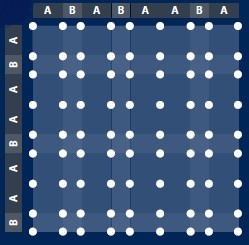
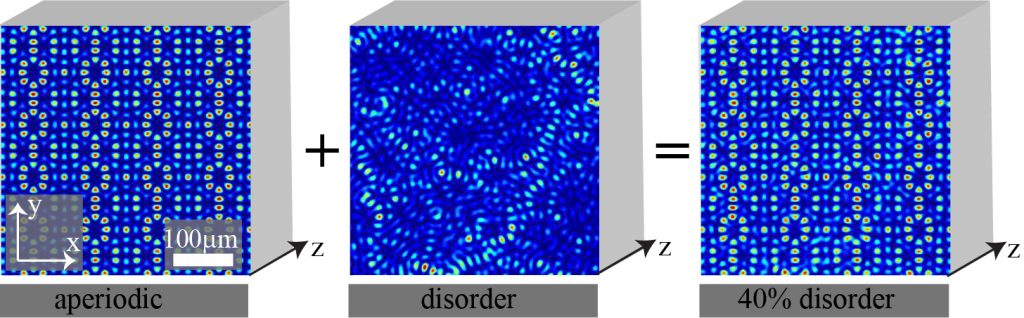
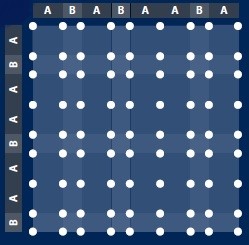
We achieve light control and manipulation by nonlinear structuring of matter with light. We combine fundamental concepts of artificially structured dielectric materials, photonic crystals, as promising candidates for advanced information processing, with the unique property of light localization as a light-matter interaction effect. Additionally, with the realization of random photonic systems, we establish a universal platform to investigate the Anderson localization of light. Quasi- and aperiodic systems in the shape of two-dimensionally arranged binary Fibonacci words are also fabricated. In comparison with the periodic systems, we proved that light transport is hampered due to aperiodicity.
Nondiffracting and accelerating beams
Recently, we started to combine the knowledge about photorefractive materials with our expertise in the field of complex beam shaping in order to achieve completely new types of optically induced photonic lattices. Besides well-known discrete periodic structures, we developed methods to prepare two-dimensional Mathieu lattices as well as complex aperiodic structures.
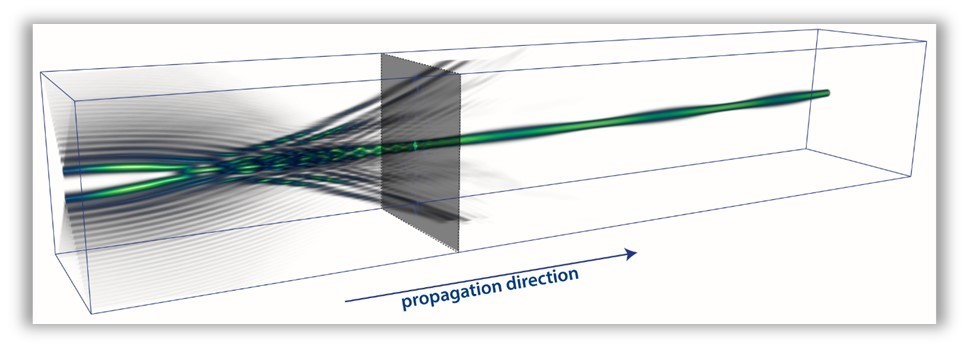
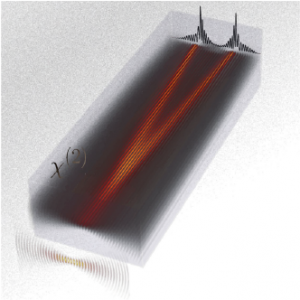
A new type of soliton formation arising from the interaction of multiple two-dimensional Airy beams in a nonlinear medium is demonstrated. In a linear regime, interference effects of two or four spatially displaced Airy beams lead to accelerated intensity structures that can be used for optical induction of novel light-guiding refractive index structures, the nonlinear cross-interaction between the Airy beams decelerates their bending and enables the formation of straight propagating solitary states.
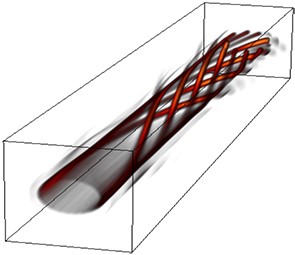
We observed nonlinear self-action of elliptic Mathieu beams leads to the formation of high-intensity filaments, which rotated in the direction determined by the energy flow. The dependence of these emerging photonic structures on the strength of the nonlinearity and the structure size of the Mathieu beams was investigated, and we pointed out that the twisted refractive index formation could act as chiral waveguides.
A kind of aperiodic photonic structure realized using the interference of multiple Mathieu-Gauss beams is demonstrated, using various beam configurations, their mutual distances, angles of rotation, or phase relations.